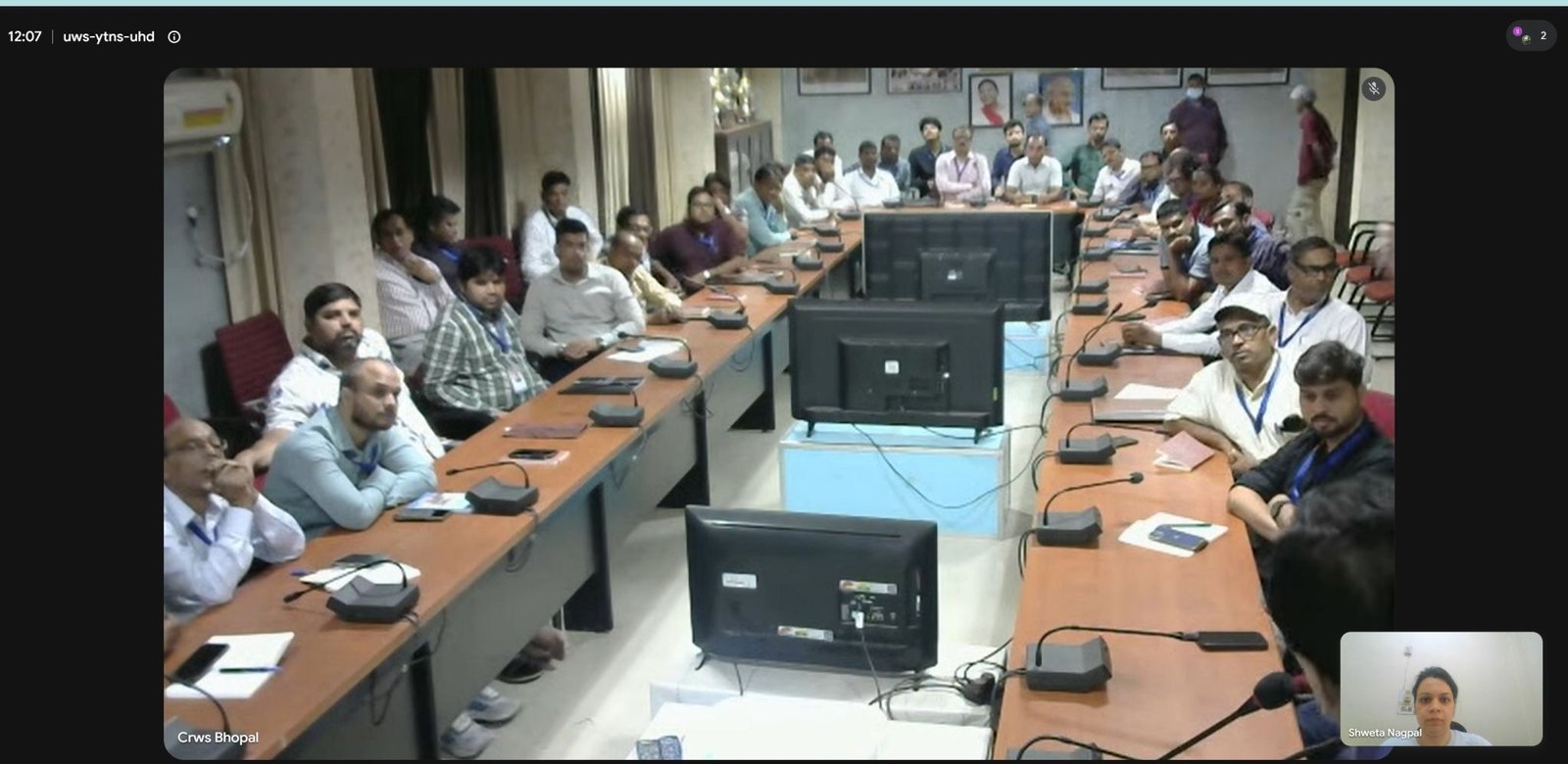
From recording to institutional practice.
Artificial Intelligence: Moving from Experimentation to Meaningful Workplace Adoption
Artificial Intelligence is no longer a technology conversation limited to IT teams. It is increasingly becoming a workplace capability that professionals across functions need to understand and apply thoughtfully.
I was invited as a Guest Lecturer to deliver a session on “Use of New Technologies – Artificial Intelligence (AI)” as part of a Management Development Programme conducted at the Technical Training Centre, West Central Railway, from 29 July to 1 August 2026. The session was conducted online on 31 July 2026.
The Management Development Programme brought together professionals for a diverse programme covering areas such as ethics and leadership, personnel management, public governance, stress management, health, personality development, HRMS, disaster management and emerging technologies.
My session focused on making Artificial Intelligence relevant to the day-to-day professional environment, rather than approaching AI simply as a collection of tools or technical concepts.
From Understanding AI to Using It Effectively
The discussion explored how professionals can use AI to enhance everyday work, including:
- researching and synthesising information;
- analysing information and identifying patterns;
- improving professional communication;
- creating and refining content;
- supporting problem-solving and decision-making; and
- exploring opportunities for workflow improvement and automation.
At the same time, the session emphasised an equally important question: Where should we not rely on AI?
Participants were encouraged to understand the limitations of contemporary AI systems, including the possibility of inaccurate or fabricated information, the importance of verifying AI-generated outputs, and the need to retain human oversight and professional judgment.
Building AI Literacy, Not Just Tool Awareness
One of the key messages of the session was that meaningful AI adoption begins with people and capability, not technology alone.
A professional does not necessarily need to become an AI specialist to benefit from AI. What is increasingly important is developing sufficient AI literacy to recognise opportunities, frame effective questions, evaluate outputs critically and understand the risks associated with using AI in a professional setting.
The objective, therefore, was not to leave participants with a list of AI tools to experiment with. It was to encourage a more structured approach:
Understand → Experiment → Evaluate → Apply → Govern
This approach can help organisations move beyond novelty-driven experimentation towards practical and responsible adoption.
Responsible AI in the Workplace
The session also highlighted the importance of responsibility when incorporating AI into professional workflows.
AI-generated information should not automatically be treated as accurate simply because it is presented confidently. Professionals need to exercise judgment, verify important information and remain accountable for decisions taken with AI assistance.
This becomes particularly important in institutional and public-sector environments, where issues such as data confidentiality, accuracy, accountability, transparency, bias and human oversight can have significant consequences.
The future of AI adoption will therefore depend not only on access to increasingly capable technologies, but also on whether professionals develop the judgment and awareness required to use them appropriately.
An Important Shift in the AI Conversation
What made the interaction particularly meaningful was the opportunity to engage with professionals from diverse functional backgrounds.
AI is gradually becoming a horizontal capability—one that can influence administration, human resources, finance, communication, research, operations and decision-making across an organisation.
The future of AI will not be shaped only by AI engineers and technology specialists. It will also be shaped by professionals who understand their own domains and learn how AI can be applied within those domains thoughtfully, effectively and responsibly.
I am grateful to the General Administration Department and the organising team at Jabalpur, West Central Railway, for inviting me to contribute to the Management Development Programme and for providing an opportunity to engage with professionals on the practical and responsible use of emerging technologies.
I look forward to continuing to contribute to AI awareness, AI literacy, responsible AI adoption and practical AI capacity building across organisations, institutions and professional communities.
Guest Lecturer | Management Development Programme | Technical Training Centre, West Central Railway | 31 July 2026 | Online Session