From recording to institutional practice.
Cyber Laws, AI, ML & IoT: Understanding the DPDP Act, 2023
As technology becomes increasingly embedded in public administration and infrastructure, understanding the legal and regulatory dimensions of digital technologies is becoming essential for professionals working across sectors.
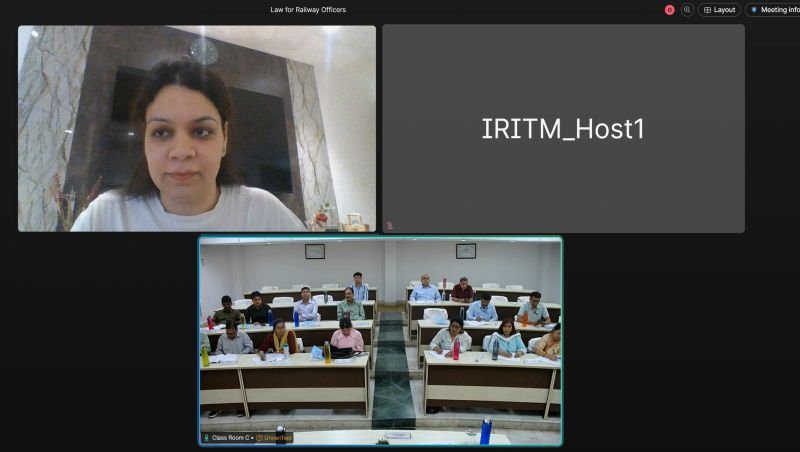
I had the privilege of delivering a session on “Cyber Laws (AI, ML & IoT) | The Digital Personal Data Protection (DPDP) Act, 2023” as part of the Law for Railway Officers course at the Indian Railways Institute of Transport Management (IRITM), Lucknow.
The session provided an opportunity to engage with Railway Officers on the rapidly evolving intersection of technology, cybersecurity, data protection and law.
Bringing Cyber Law into the Technology Conversation
The session explored how emerging technologies such as Artificial Intelligence (AI), Machine Learning (ML) and the Internet of Things (IoT) are changing the way organisations collect, process, analyse and use information.
While these technologies create significant opportunities for improving efficiency and decision-making, they also introduce new legal, ethical and governance considerations.
The discussion therefore went beyond understanding technology itself and focused on an important question:
What legal and governance responsibilities arise when organisations increasingly depend on digital technologies and data?
Understanding the DPDP Act, 2023
A significant component of the session focused on the Digital Personal Data Protection Act, 2023, and its relevance in an increasingly data-driven environment.
The discussion helped participants appreciate why personal data protection needs to be considered alongside digital transformation and technology adoption.
For professionals working in large public institutions, understanding data protection is particularly important because digital systems routinely interact with information relating to employees, citizens, passengers, vendors and other stakeholders.
The session therefore connected the broader principles of data protection with the practical realities of technology-enabled institutional processes.
Why Cyber Law Matters for Railway Officers
Indian Railways represents a complex technology ecosystem where digital systems, communications infrastructure, operational technologies, connected devices and large-scale data processing intersect.
As technology continues to evolve, legal awareness cannot remain confined to legal or IT teams.
Officers across functional domains increasingly need to understand:
- how emerging technologies affect legal and regulatory responsibilities;
- the importance of protecting personal and sensitive information;
- the implications of using AI and automated systems;
- the relationship between cybersecurity and organisational governance;
- why technology adoption needs appropriate safeguards and accountability; and
- how legal awareness can support better digital decision-making.
Connecting Technology, Law and Governance
One of the most important aspects of the session was the opportunity to interact with professionals who brought their own operational perspectives and questions to the discussion.
Such interactions reinforce an important principle: technology governance cannot be separated from the context in which technology is actually used.
AI, ML, IoT and data-driven systems are not merely technical implementations. Their use can have implications for privacy, accountability, security, transparency and individual rights.
Building awareness among professionals is therefore an important part of creating organisations that can adopt emerging technologies while managing their associated risks.
Building Digital and Legal Literacy
As technology continues to reshape public administration and infrastructure, cyber-law awareness is becoming an essential component of professional capacity building.
The objective of such sessions is not to turn every professional into a technology lawyer or cybersecurity specialist. Rather, it is to enable professionals to recognise legal and governance considerations early, ask the right questions and make better-informed decisions when working with digital technologies.
I am grateful to Mudit Anand, IRSSE, Sr. Professor (S&T) and Course Director, for the invitation and for designing a learning programme that recognises the importance of contemporary legal knowledge for Railway Officers.
It was an honour to contribute to a programme focused on equipping professionals with the knowledge required to navigate the increasingly interconnected world of law, technology, cybersecurity and data protection.